.png)


Cyprus Before the Crowds: 7 Nights for £355 Each (All Costs Included)
Updated: May 15
In March 2025, we spent a week road-tripping around Cyprus for just £355 per person , and that covered everything: flights, accommodation, car hire, petrol, food, drinks… the lot.
No loyalty points. No freebies. No cutting corners. Just deliberate choices, travelling slightly off-season, and staying somewhere that most tourists would go straight past.
Instead of booking a familiar resort near rows of British bars and all-inclusive wristbands, we based ourselves in a working Cypriot village, in what locals would still consider winter. It was quieter in the evenings, yes. But it also meant balconies overlooking fields and a softly lit Greek Orthodox church, unhurried glasses of wine at sunset, and everyday life unfolding around us. Children walking to school, neighbours stopping to talk, church bells marking funeral services.
Cyprus in March isn’t about sunbeds and pool music. It’s about blossom on orange trees, empty coastal paths, and the feeling that you’ve stumbled into something more real.
We had beaches almost entirely to ourselves. In some of the larger resorts, the promenades felt like film sets waiting for the actors to arrive. You could smell fresh paint in the air and hear the buzz of power tools as hotels prepared for the season ahead.
It was fascinating to wander through streets that, in a matter of weeks, would be full to capacity with music blaring from every bar, children darting between tables, quad bikes revving, ticket sellers calling out for business.
There’s a version of us in our twenties who would no doubt have hated the quietness! We’d have wanted the atmosphere, the noise, the buzz of being in the middle of it.
But now? The quiet felt like a gift.
At this stage in life, we don’t need constant entertainment. We want space. We want views. We want a balcony, a bottle of wine, privacy, and time to talk about politics and current affairs without shouting over background music. Travelling off-season didn’t feel like we were missing out. It felt like we’d finally worked out what we actually enjoy.
For seven days, that village became our base while we explored coastlines, mountain roads, hiking trails and hidden coves across the island.
In this post, we’ll show you exactly where we stayed, everywhere we went, and precisely what it cost, so you can decide whether a trip like this might change the way you holiday too.
Day One - First Impressions, Empty Beaches, and Finding Our Rhythm
We were staying in the village of Xylofagou, slightly inland from the coast, not somewhere you’ll find in any package holiday brochures. That was deliberate.
Waking up on our first proper morning, we knew the day wasn’t going to be about ticking sights off a list. It was about ticking food and drink off the shopping list that we'd carefully curated on our flight over the previous day. So we drove towards Protaras and headed straight to Lidl. Boring and practical? Yes. Essential? Absolutely.
A trolley filled with yoghurt, bread, meat, salad bits, coffee, and pastries (for immediate consumption). We took those straight to the beach and ate them overlooking an almost deserted stretch of white sand in Protaras. Supermarket brunch, Mediterranean backdrop, barely another soul in sight. It felt faintly ridiculous yet completely perfect!
On the drive back to the apartment we passed through Ayia Napa, noticing just how quiet it was. We drove past the turn-off for the Sea Caves and Cape Greco, making mental notes for later in the week.
Resorts that would soon be pulsing with music were subdued, almost contemplative. You could see fresh paint drying on hotel balconies. In a few weeks’ time, these streets would be full with holidaymakers.
For now, they were still.
Back at the apartment, we unpacked the groceries and had a simple homemade lunch, another small decision that helped keep that £355 total realistic without feeling restrictive.
Later that afternoon we headed back out, this time towards Makronissos Beach. We stopped first to explore the nearby Makronissos Tombs, then walked down onto the sand. The beach was practically empty.
The sea was that startling, glass-clear blue that photographs never quite capture properly. We stood there for a moment slightly stunned, partly by the colour of the water, partly by the fact that in peak season this same stretch of sand would be lined with sunbeds and it would be tricky to find a parking space, let alone one for free.

Makronissos Beach was also our first proper introduction to the Cyprus cats.
They were everywhere. Some bold and friendly, weaving confidently between beachgoers. Others more cautious, watching from under shrubs or stacked sunbeds. A couple were in the middle of a dramatic disagreement, and another tried multiple times to pee on our beach bag!! At one point, a small procession of them followed us along the beach path as if we were Pied Pipers with pockets full of cat treats.
Click left to see our montage of Cyprus Cats on Instagram, and the little feline parade following us back from the beach.
In case you didn't know, Cyprus has thousands of street cats, cared for locally and very much part of daily life. By the end of the week, they’d become a familiar and oddly comforting presence.
Day one wasn’t dramatic. It was orientating ourselves, observing, easing in. And it was exactly the right way to start.
Day 2 – Sea Caves, Sculpture Parks, and the First Taste of the Mountains
We set off early.
One of the advantages of travelling off-season is that you don’t have to get up at dawn to beat the crowds, but sometimes it’s still worth it. We arrived at the sea caves near Ayia Napa just before 9am, the air still cool and the light soft across the rocks. A small minibus of early-bird tourists was just leaving as we pulled in. Within minutes, we had the place to ourselves.
We scrambled carefully down through the rocks, picking our way towards the edge. Below us, the sea shifted between deep sapphire and impossibly clear turquoise, the kind of colour that doesn’t look real until you’re standing right above it.
We sat for a while, not saying much, just watching the water move.
From there, we continued into Cape Greco, following the winding road through the national park. The route itself was the attraction, each turn revealing another viewpoint, another rocky outcrop, another stretch of coastline.
We stopped at the natural rock arch, stood quietly by the small white church overlooking the sea, and pulled over whenever something caught our attention. There was no rush. No schedule. Just exploration.
As the morning went on, more vehicles began arriving. Tour groups. Hire cars. The gentle quiet we’d started with was beginning to shift... so we moved on.
We drove inland to Paralimni, curious to see somewhere less shaped by tourism. It was a proper working town with everyday life fully in motion. Shops open. People going about their routines. Conversations in doorways between ladies laden down with shopping bags.
We quickly became aware that we stood out slightly, dressed more for the coast than town streets. Not in an unwelcome way, just noticeable. It reminded us that we were visitors passing briefly through someone else’s normal day. After a short wander taking in the exterior of the town's central church, we slipped away again, back to the car.
Back in Ayia Napa, we stopped at the Sculpture Park. It was completely free to enter, and unexpectedly peaceful. Modern sculptures were scattered across the hillside, overlooking the Mediterranean below.
We found a bench and ate the sandwiches we’d brought with us, surrounded by art, sea views, and warm midday sun. It was one of those simple travel moments that stays with you, nothing extravagant, nothing staged. Just being there.

Later that afternoon, after heading back to freshen up and change, we set off again this time inland, towards the mountains.
The landscape shifted gradually. Coastal flatness giving way to hills, then winding roads climbing higher into quieter terrain. We made a brief stop in the village of Kato Drys, exploring its beautiful old buildings and churchyard, then on to Pano Lefkara, known for its traditional lace-making.
Lefkara lace is so highly regarded that even Leonardo da Vinci is said to have visited the village in the 1400s, purchasing a piece for the altar of Milan Cathedral. Walking through the quiet streets, it wasn’t hard to imagine how little some parts of this place must have changed. It felt like stepping into a different version of Cyprus entirely.
As we drove back down towards the coast, the sun began to lower behind the hills, casting long shadows across the road ahead. It was our first real glimpse of mountain life — and a reminder that later in the week, we’d be heading deeper into the heart of the Troodos Mountains.
We drove home relaxed and happy, already looking forward to what was still to come.
Day 3 – Crossing the Line: A Day in Divided Nicosia
Today was about understanding a different side of Cyprus.
We’d both been fascinated by the story of Nicosia, the last divided capital in Europe, and had brought our passports with us so we could cross between the Greek Cypriot south and Turkish-controlled north.
The drive there was uneventful in the best possible way. It was technically rush hour, yet traffic flowed easily. We couldn’t help comparing it to being stuck nose-to-tail on the M62 back home, watching the minutes tick by. Here, everything felt calmer.
We began in the modern Greek Cypriot side of the city. At first glance, it looked like any contemporary European capital, with international retail chains, car dealerships, cafés and restaurants lining wide streets. Sleek. Familiar. Bustling.
Our first stop was the Cyprus Museum, which is free to enter and absolutely worth the visit. Inside, rooms were filled with artefacts tracing the island’s history back thousands of years. Pottery, sculptures, tools, all little reminders that Cyprus has been lived in, fought over, and shaped for millennia.

From there, we walked towards Paphos Gate, part of the old Venetian city walls. Nearby stood an abandoned UN watchtower close to the Green Line. It was a silent, physical reminder of the division that still exists today.
It was here that we noticed one of Cyprus’s ever-present cats, chilled out and completely at ease, cleaning itself in the middle of it all. Oblivious to the history that had unfolded on those same streets years before.
We also passed young UN peacekeepers as we walked, which felt a bit surreal. Seeing them in person made the reality of the situation feel far more tangible than anything you read in travel guides.
Eventually, we reached Ledra Street, one of the main shopping streets. International brands, fast food outlets, and pavement cafés filled with people enjoying lunch in the sun. It felt lively, modern, and entirely normal. And then, at the end of the street... the checkpoint.
Crossing was surprisingly straightforward. Passports checked. A brief pause. Then through.
Stepping out on the other side felt like entering a completely different country.
The architecture shifted. The atmosphere changed. Things felt older. Slower. Less polished. Not worse, just different. The streets were narrower. Shop signs changed language. Mosques replaced churches on the skyline. It wasn’t dramatic or intimidating. It was just… noticeable.
Our first stop was Büyük Han, a beautifully restored 16th-century caravansarai now home to independent craft shops and small restaurants arranged around a central courtyard. Tour groups milled about, and we were suddenly aware of how hungry we were.
We found a quiet bench and pulled out our picnic. Around us, plates of freshly prepared Turkish food were being served such as grilled meats and flatbreads, dishes rich with colour and aroma. For a moment, we felt a small pang of regret over our homemade sandwiches. But travelling on a budget means making choices, and those choices had brought us here. Maybe next time, we said.
After eating, we wandered through the artisan shops. The atmosphere was relaxed and welcoming. Shopkeepers were friendly without being pushy, seeming genuinely pleased that people were there, even just to look.
We continued towards the nearby Selimiye Mosque, but restoration work meant it was partially hidden behind scaffolding. Only the minaret towered above the boards, hinting at what lay beyond.
As we explored further, the contrast with the southern side became more apparent. Buildings were more worn. Streets quieter. The city carried its age more visibly.
We eventually found our way to Samanbahçe, a historic social housing project restored by UNESCO in the early 2000s. The small, uniform homes stood neatly arranged, and the people living there seemed proud of their community, smiling and waving as we walked through. There was no sense of intrusion, just a feeling of shared space and mutual respect.
Later, as we made our way back towards the border, we stopped at a traditional bar and ordered a pint of Efes each. Inside, older locals sat together in conversation, the easy familiarity of long-standing routines. Outside, stallholders and customers called out to one another across the street, helping elderly neighbours with their shopping bags, exchanging greetings and gossip. There was a deep sense of community, something unforced and deeply rooted. We sat quietly, observing, grateful just to be there.

Crossing back into the Greek Cypriot side was just as straightforward. As we walked once more near Paphos Gate, we heard the call to prayer drifting across the Green Line. The sound carried through the late afternoon air. It was distant, haunting, and strangely beautiful.
By the time we reached the car, we were tired and warm from the day. Traffic leaving the city was easy, and as we drove away, we glanced in the rear-view mirror and saw it — the enormous Turkish flag embedded into the mountainside on the northern horizon. An unmistakable reminder that we had just spent the day moving between two halves of one city. And two very different versions of Cyprus.
As we left the city behind and the roads grew quieter, we made two final stops to places we’d seen online and wanted to explore for ourselves. The first was Agios Theodoros Heart, a simple heart-shaped sculpture positioned to frame the village and landscape beyond. Standing there, looking out across the scenery, it felt symbolic. Cyprus had already given us so much in just a few days. History, contrast, beauty, and perspective.

A little further down the road, we stopped again at the Heart Seaview Point, a wooden sculpture right by the coast, its shape framing the endless blue of the Mediterranean. The sea was calm, and the light was beginning to soften as the afternoon edged towards evening. We stayed a while, watching a fisherman in his boat, casting and checking nets. Could he have been trying to find the 'Catch of the Day' for the fish restaurant we were parked next to?

By the time we arrived back at the apartment, we were tired but thoughtful. The day had shown us a side of Cyprus far removed from beaches and holiday resorts. A place shaped by history, resilience, and quiet coexistence. And it left us with a deeper appreciation of the island as a whole.
Day 4 – A Beach Day, and Pizza Preparations for the Mountains
After several days of exploring, driving, and absorbing new places, we gave ourselves permission to slow down. No alarm clocks. No plans. Just the beach.
We returned to Makronissos Beach, which had already made an impression on us earlier in the week. This time, instead of passing through, we stayed.
The morning slipped by easily. Swimming in the clear, cool water. Stretching out on the sand in the 'winter' heat. We overheard an ex-pat paddleboarder commenting on how superb the 28 degree heat was for this time of year. We were so fortunate to experience Cyprus like this...warm and far quieter than it would ever be in peak season.
There was no background music. No rows of tightly packed sunbeds. Just the steady rhythm of the sea and the warmth of the early spring sun.
At lunchtime, we pulled out our picnic. It was simple food, but somehow it tasted better eaten with sandy hands and salt still on our skin from the sea. Travel doesn’t always need to be about doing more. Sometimes, it’s about allowing yourself to stop.
We stayed for most of the day, reluctant to leave but aware that tomorrow would take us somewhere very different.
Back at the apartment that evening, we turned our attention to dinner and to preparation for the next day’s mountain adventure. With no weighing scales, no rolling pin, and only basic kitchen equipment, we made our homemade pizzas using our usual simple recipe: Greek yoghurt and self-raising flour. Improvised, misshapen, but entirely functional.
We topped them with ingredients we'd bought from Lidl, including Greek oregano and olives that added an unmistakably local flavour. It felt fitting somehow — using something bought just days earlier in Protaras, now part of a meal in our temporary Cypriot home.
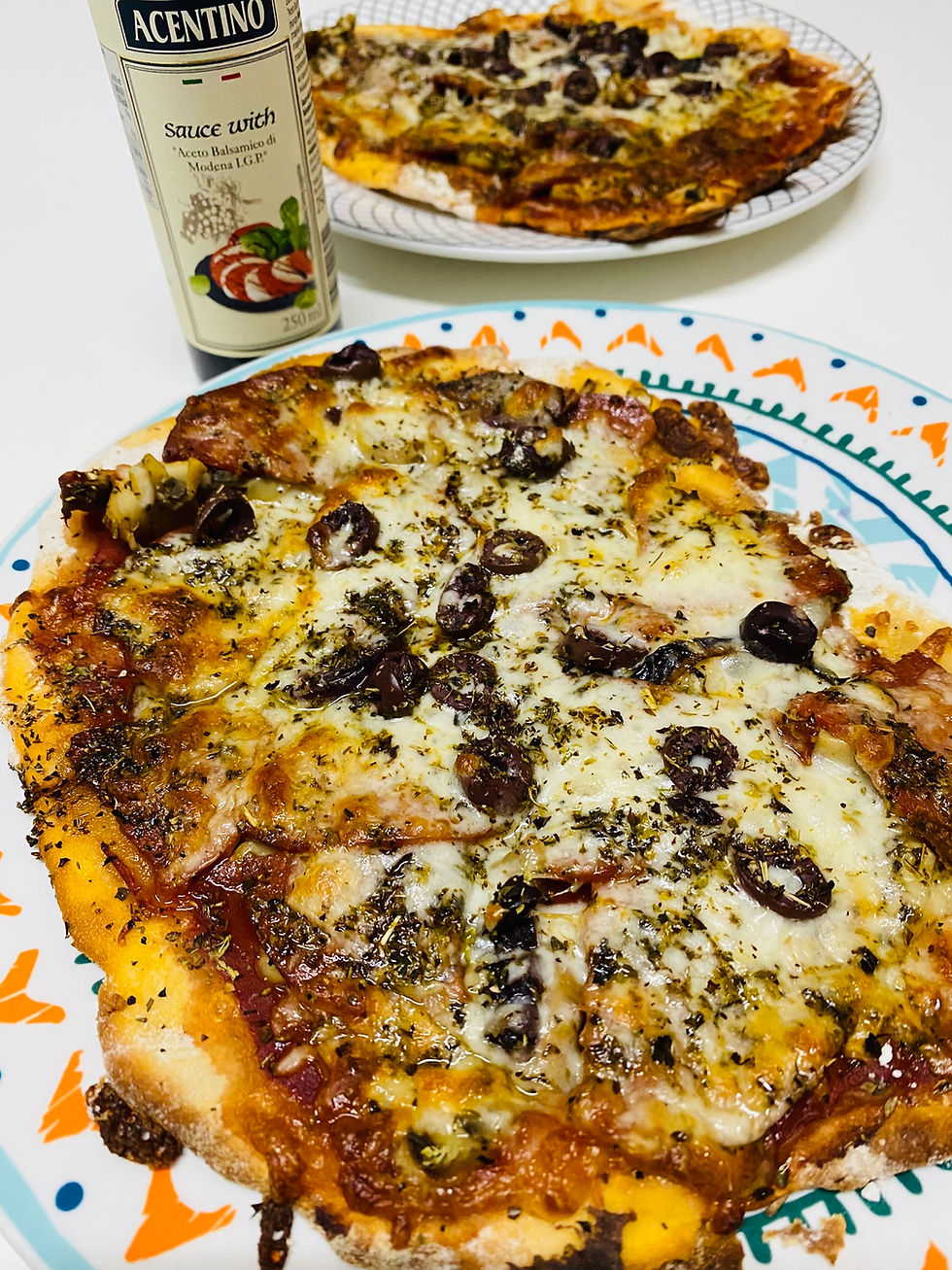
We made enough for the following day too, carefully setting some aside for our picnic lunch in the mountains. It wasn’t fancy. It wasn’t Instagram-perfect. But it was ours.
And it was exactly the kind of travel we’d come for.
Day 5 – Into the Troodos Mountains: Shrines, Snow, and Silent Places
We set off early, leaving the coast behind and heading inland, this time with the Troodos Mountains firmly in our sights. The route took us skirting around Nicosia, before the landscape began to change. Flat terrain gave way to hills, then dense forest. The air grew cooler and fresher, the kind that makes you instinctively breathe more deeply.
Our first stop was the Komititzi Picnic Site, a forest rest area tucked among tall pine trees. We’d originally pulled in for practical reasons (Cyprus, we’d quickly discovered, is exceptionally well served by free public loos, even in the most remote places!) But the stop became something more.
There was no one else around. No engines. No voices. Just birdsong, trees shifting gently in the breeze, and that unmistakable mountain stillness. The air smelled faintly of pine and sun-warmed earth. It felt a world away from the beaches.
As we climbed higher, we passed the hilltop setting of Kykkos Monastery, its position striking even from a distance. We stopped briefly to admire the view and capture a photo before continuing on to the nearby tomb of Archbishop Makarios III, the first President of Cyprus and one of the most important figures in the island’s modern history.
Set high on the mountainside, his tomb occupies a position that feels both peaceful and deliberate, overlooking vast stretches of forested landscape below. Armed guards stood watch nearby., subtly readying their rifles whenever tourists tried to peer inside, not aggressively, but as a quiet reminder that this was still a place of national importance, not simply a viewpoint.
We stayed there for over an hour, taking in the peaceful mountain scenery. Just the sound of birds, the warmth of the sun, and the vastness of the Troodos range stretching out in every direction.
After leaving the tomb, we continued deeper into the mountains. Near the village of Pedoulas, we spotted a small white church perched alone on a hillside. It looked simple from a distance, almost plain, but something about its position drew us in. We turned off the road and drove slowly up the steep approach, arriving at an empty car park surrounded by sweeping mountain views.
The church itself was stark white on the outside, crowned by a tall cross rising high into the sky. We assumed it would be locked because in the UK, a remote building like that would almost certainly be closed. But when we tried the door, much to our surprise it opened.
Inside was something extraordinary.
Every surface was covered in vibrant Greek Orthodox artwork. Intricate, colourful, and impossibly detailed. Saints, icons, gold accents, deep blues and reds, floor to ceiling, wall to wall.
It was breathtaking.
Neither of us are religious, but there was something undeniably spiritual about standing there alone in that space, high in the mountains. The silence, the isolation, and the beauty of the artwork combined into something magically profound. We both agreed it was hard to imagine somewhere so open and unprotected remaining untouched back home.
From there, we continued climbing towards Mount Olympus, the highest point on the island. As we gained altitude, the landscape changed again.
At first, it was just cooler air. Then suddenly, patches of snow appeared at the roadside. Then more. And more. Eventually, we found ourselves surrounded by it.
We passed the Cyprus Ski Club, complete with chair lifts stretching up the mountainside. It felt surreal standing there in T-shirts, sweating from the warmth of earlier in the day, yet surrounded by snow and mountain cold. Cyprus had surprised us again.
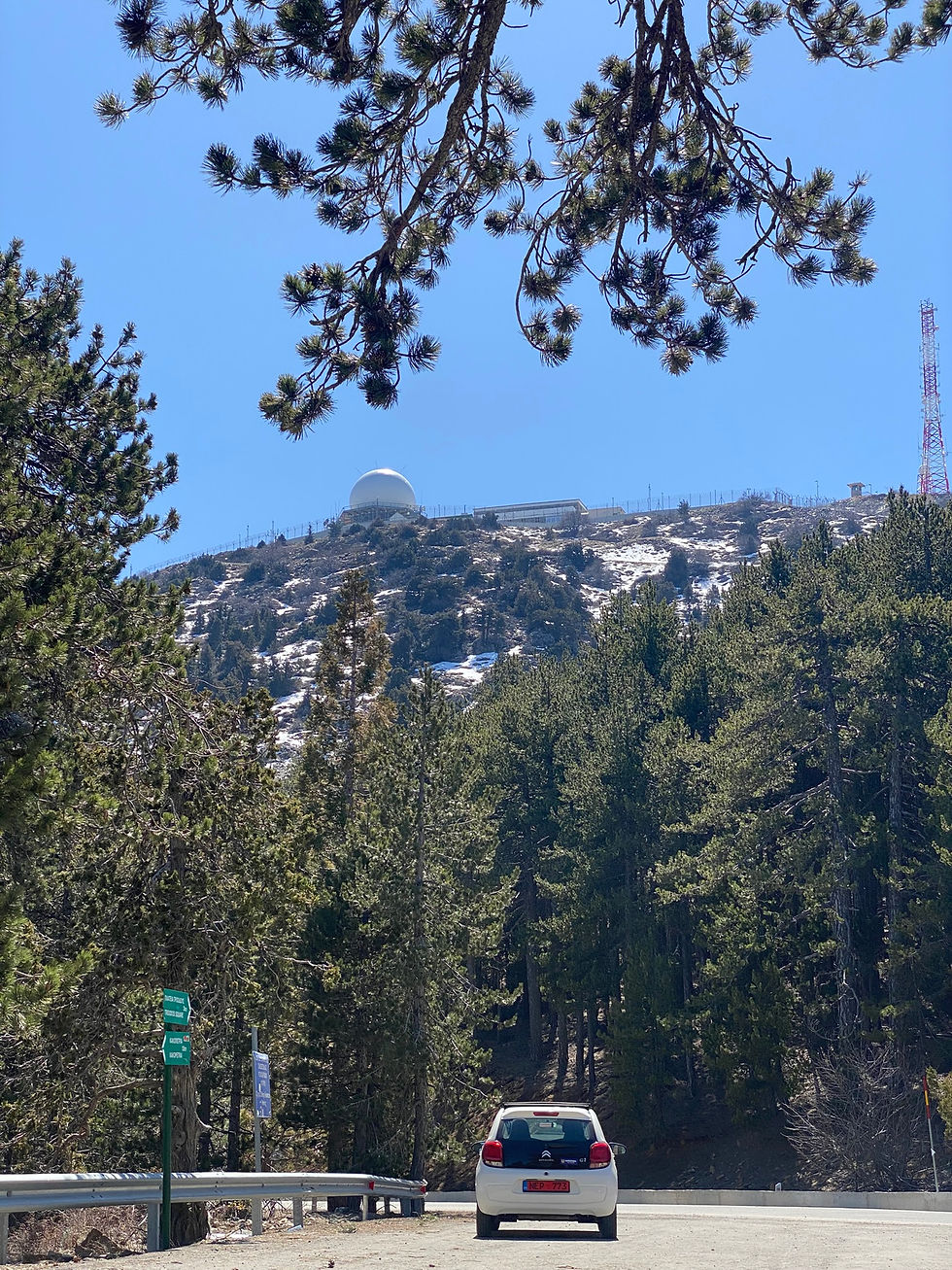
We began the descent towards the village of Platres, pulling into a layby with a viewing platform along the way. Sitting there above the forested valleys below, we ate the homemade pizzas we’d prepared the night before. It was simple, but perfect.
From Platres, we followed the trail to Caledonia Waterfall, walking through shaded forest as the sound of running water slowly grew louder. The walk felt long in the heat and humidity, but it was absolutely worth it. The waterfall appeared suddenly through the trees, tumbling down through the rocks in the middle of the forest. Wild. Quiet. Untouched. By the time we made it back to the car, we were hot, tired, and ready to head home.
That evening, after showers and a simple home-cooked meal, we sat out on the balcony overlooking the softly lit Greek Orthodox church across the field. And then, just as the day seemed ready to end quietly, we had one final visitor... a giant praying mantis landed on the balcony. Before we could react, it calmly walked through the open patio doors and into the apartment as if it belonged there. What followed was fifteen minutes of careful negotiation, gently guiding and persuading it back outside. It was enormous. Beautiful. Completely unexpected. We watched it disappear into the night and sat back down, laughing.
It had been a day of mountains, snow, silence, and surprise. A day that showed us yet another version of Cyprus we never would have seen from a sunbed.

Day 6 – Laundry, Last Swims, and Balcony Reflections
Our final full day was intentionally slow. No alarm. No long drives. No plans beyond returning to the place that had quietly become our favourite — Makronissos Beach.
We’d seen a lot over the previous five days, coastlines, mountains, villages, and cities divided by history. Now it felt right to simply stop and enjoy it.
Before leaving the apartment, we set the washing machine going and hung our clothes out to dry in the balcony sun. One of the unexpected luxuries of having self-catering accommodation wasn’t just the kitchen, it was the ability to reset everything before going home. Not to mention the fact that (maybe it's an age thing?!?) there's something so incredibly satisfying about doing laundry abroad...it dries quickly, and we can go home feeling smug that there's no post-holiday washing to do when we get back to the UK!
After our day luxuriating on the beach, we did a practice run of repacking everything into our underseat bags. It had become a point of pride to travel for a full week with so little, and still having everything we need. No excess. No wasted space. No baggage fees, Just deliberate choices. Once everything was packed and ready, we made dinner one last time and settled onto the balcony with a few final drinks, looking out towards the softly lit church that had become such a familiar part of our evenings.
There was no sadness, exactly. Just that calm, reflective feeling that comes at the end of a good trip, knowing you’d seen what you came to see, and lived the kind of travel you’d hoped for.
Tomorrow, we would leave. But Cyprus wasn’t finished with us just yet.
Day 7 – One Last Swim, Flamingos, and Goodbye to Cyprus
We didn’t have to leave the apartment until noon, but neither of us wanted to waste the morning.
We’d already made a plan. One last visit to Makronissos Beach, with pastries from the bakery in Xylofagou.
By 8:30am, we were there.
The sea was calm. The sand untouched. The only other people around were a local swimming club, just finishing their morning session before heading to the small beachside café for coffee. And then, they left.
For a while, we had the sea entirely to ourselves! We ate our delicious pain au chocolat slowly, sitting on the sand, taking it all in. The quiet. The light. The familiarity of a place that had, somehow, started to feel like ours. There are definite advantages to getting up early.

Leaving the apartment for the final time was easier than expected. Everything packed neatly back into our underseat bags, just as it had been when we arrived.
We drove towards Larnaca, planning to spend a few hours there before heading to the airport.
We hadn’t realised quite how lovely it would be. It was Sunday, and the seafront promenade was alive with families walking, talking, sharing meals together. Restaurants were full. Children played along the boardwalk. The atmosphere felt warm, social, and a showcase of everyday life rather than tourism alone.
We wandered along the waterfront, admiring the mix of Venetian-era architecture, churches, and mosques, and watching planes glide low overhead as they lined up for landing. It felt like a fitting final window into Cypriot life.
Before returning the car, we made one last stop at the nearby Larnaca Salt Lake, home to the beautiful Hala Sultan Tekke, which sat peacefully beside the water. We found a bench and ate our final homemade snack, the boiled eggs we’d prepared the day before, and watched the stillness of the lake.
And then we saw them... Flamingos.
Too far away for our cameras to capture clearly, but unmistakable in shape, colour and movement. Elegant. Unbothered. Exactly where they were meant to be. A small, unexpected final gift from the island.

Soon, it was time to return the car. The process was effortless. Efficient. The woman who drove us back to the airport was warm and friendly, chatting easily as we made the short journey. As we stepped out, she smiled and said she hoped we’d come back someday.
We hoped so too.

And just like that, it was over.
Seven nights. Mountains, beaches, villages, cities, history, silence, and surprise.
All of it carried home in two small underseat bags.
Final Thoughts – What £355 Each Really Gave Us
When we tell people we spent a week in Cyprus for £355 each, the first reaction is usually disbelief. There must be a catch. Hidden extras. Compromises. But there weren’t.
That figure covered everything: flights; car hire; petrol; accommodation; food; parking; airport alcoholic drinks; even the small, forgettable purchases that usually slip through the cracks of memory. What it didn’t mean was deprivation. We didn’t miss out. We didn’t feel restricted. We didn’t spend the week wishing we were somewhere else, or doing something more expensive.
What £355 gave us was freedom.
Freedom to explore at our own pace. Freedom to sit quietly on empty beaches. Freedom to drive into mountains, wander unfamiliar streets, and follow curiosity wherever it led. It gave us balcony evenings watching village life unfold below us. Homemade meals made with local ingredients. Early mornings with the sea entirely to ourselves. It gave us perspective.
Travelling this way isn’t about doing things the cheapest way possible. It’s about doing them deliberately. Choosing what matters, and quietly letting go of what doesn’t. We didn’t stay in luxury resorts. We didn’t eat out every night. We didn’t fill every moment with activity. And yet, we experienced more of Cyprus than we ever could have from behind the walls of an all-inclusive hotel.
At this stage of life, travel feels less about escape and more about connection to places, to people, and to ourselves.
Cyprus gave us coastline and mountains, history and stillness, familiarity and surprise. And it proved something we’ll carry forward into future journeys:
You don’t need to spend more to experience more.
Sometimes, you just need to travel differently.
You can watch our Instagram reel with a full cost breakdown by clicking left.
Don't forget to follow us and check out our other reels on Cyprus and so much more!


Comments