.png)


How We Travel for a Week With Just an Underseat Bag (And Why We’ll Never Go Back)
Updated: May 15
For years, we assumed travel meant suitcases.
Wheels rattling over pavements. Waiting at baggage reclaim. Paying extra fees we really resented. Then, almost by accident, we tried travelling with just an underseat bag.
It changed everything. Not just how we packed — but how we travelled.

Why we started doing it
Back in the day, luggage was always included in flight prices. It would have seemed absurd if it wasn’t. How else were you supposed to take everything you needed for a two-week self-catering holiday to Majorca?
Then came the budget airlines, with a whole new way of doing things. Suddenly, that trusty suitcase came with its own price tag. Was it really worth dragging everything but the kitchen sink across Europe if you now had to pay extra for the privilege?
We didn’t think so. So we adapted. We learned to travel with smaller cabin bags, packed more carefully, and discovered that we needed far less than we’d always assumed.
Fast forward to today, and even a cabin suitcase can feel like a luxury add-on. That “cheap” £28 return flight to Marrakesh quickly becomes something else entirely once the extras start creeping in.
Travelling lighter stopped being about convenience. It became about freedom and keeping travel accessible.
At first, we didn’t go straight to underseat bags. That felt like a step too far. But gradually, trip by trip, we realised we were packing cabin cases out of habit, not necessity.
What we gained by travelling lighter
At first, travelling with less felt like a compromise. But very quickly, we realised it gave us far more than it took away.
We were able to leave the airport immediately after Passport Control instead of loitering around baggage carousels with fingers crossed hoping that our suitcases would actually have been loaded on to our plane. Of course, you can do this with a cabin suitcase too. But even those come with their own limitations.
With a small underseat backpack or tote, your hands are usually free as you step out into unfamiliar streets - useful for checking maps, navigating public transport, or simply carrying a much-needed post-flight drink. With a pull-along cabin bag, you don’t have that same ease of movement.
Many destinations, especially older historic areas, come with cobbled streets and uneven stone steps. Wheeled suitcases and cobbles are rarely a happy combination. What looks manageable on smooth airport floors quickly becomes awkward and tiring elsewhere.

With an underseat bag on your shoulder or back, getting around on foot feels noticeably easier. The same applies to public transport. Larger bags often need to be stored on luggage racks away from where you’re sitting, which can feel inconvenient and occasionally unsettling. Smaller bags stay close , under the seat in front of you, or on your knee - removing that anxiety entirely.
Over time, we’ve also realised that less luggage brings something less obvious: less mental clutter.
There’s something quite liberating about travelling with only what you truly need. No constant checking. No worrying about leaving things behind. No repacking and reorganising at every stop. Just the freedom to move forward without carrying more than necessary.
And, of course, there’s the financial side. When you find genuinely cheap flights (like our return tickets from the UK to Cyprus for £42 each) you want to enjoy that feeling of having found something rare. It’s frustrating when that price more than doubles once baggage is added.
Travelling lighter allows those savings to stay where they belong, making travel possible in the first place.
The compromises we actually make
Of course, travelling with less luggage means travelling with fewer clothes. Getting that balance right is something of an art. We’d be lying if we said it was effortless, or that we’ve never been tempted to add a last-minute bag when packing feels particularly tight. But over time, we’ve developed a system that works for us.
One of the most important things we do is try everything on before we pack. There’s no room for guesswork when space is limited. Finding out too late that something doesn’t fit properly, or doesn’t work with the other items you’ve brought , is absolutely NOT an option.
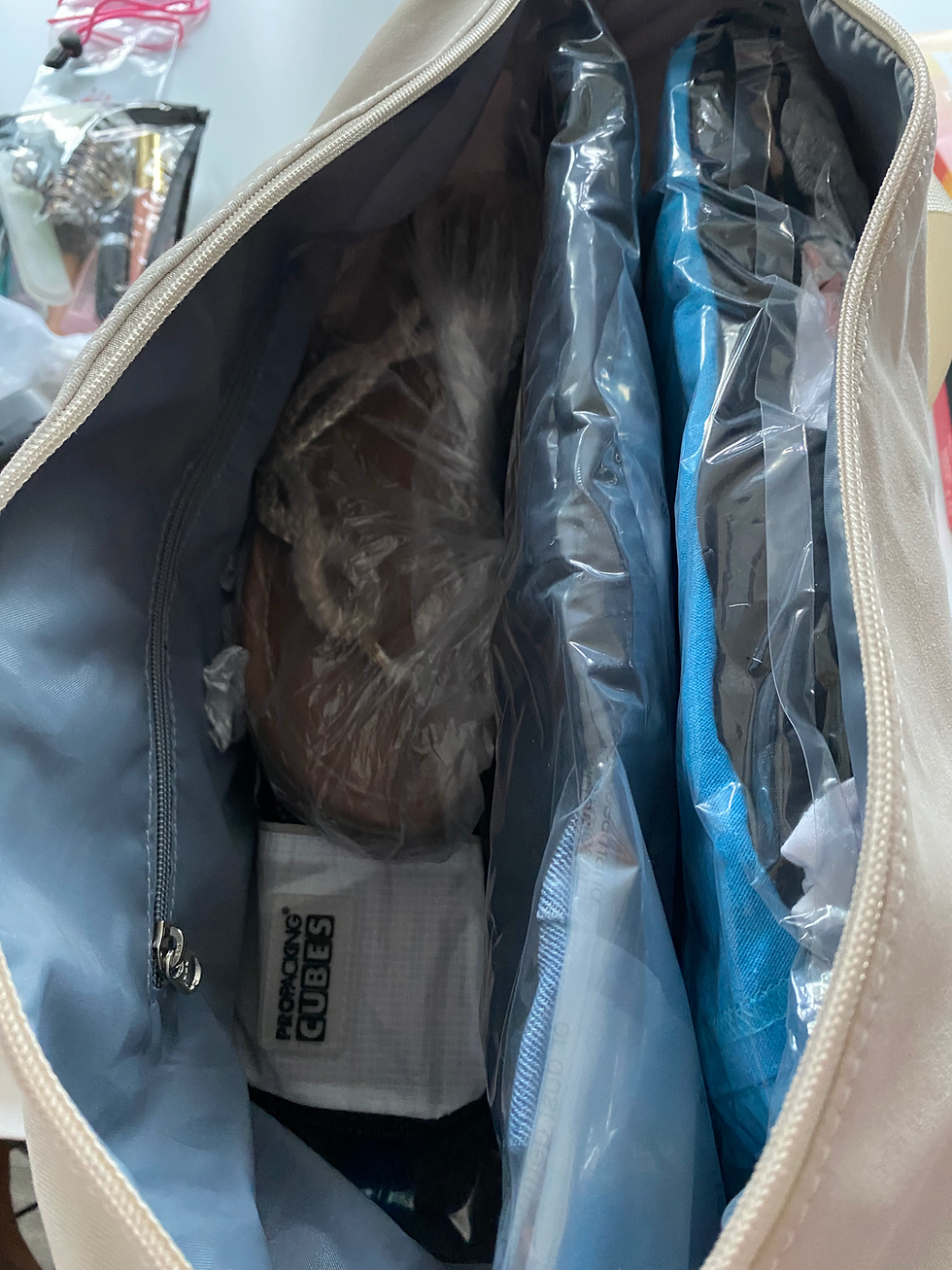
We tend to choose a small number of tops and even fewer bottoms, making sure everything works together. If a top only goes with one pair of bottoms, it doesn’t come. Every item has to earn its place by being wearable in multiple combinations.
We also take fewer underwear items than we would traditionally pack, knowing there’s always the option of a quick handwash if needed. It sounds more inconvenient than it actually is, and it quickly becomes part of the routine.
Bulkier items such as coats, jeans, walking shoes etc are worn on the plane, leaving only lighter fabrics to pack in the bag itself.
And yes, we use compression packing cubes or vacuum bags to make the most of the space available. They don’t magically create more room, but they do make everything far more manageable.
None of this feels like a hardship anymore. It’s just part of how we travel now.
Choosing the right airline matters too
Not all airlines are equal when it comes to underseat bags, and this can make a surprising difference to how much you can comfortably take.
EasyJet, for example, allows a slightly larger free underseat bag than Ryanair or Jet2. It may not sound like much on paper, but in practice those extra few centimetres make packing noticeably easier.
Because of this, we often find ourselves favouring EasyJet when prices are similar. It allows us to travel the way we prefer without having to compromise quite as much on what we bring.
It’s a small detail, but over time, these small details make travelling lighter far more manageable.
The key comparison (accurate current allowances)
Here’s the factual comparison you can include:
Airline | Free underseat bag size | Notes |
easyJet | 45 × 36 × 20 cm | Most generous of the three |
Ryanair | 40 × 30 × 20 cm | Smaller allowance, stricter enforcement |
Jet2 | 40 × 30 × 20 cm | Same size as Ryanair, but includes cabin bag in some fares |
That extra 5 cm height and 6 cm width on easyJet makes a noticeable difference in real-world packing.
Why we’ll never go back
What started as a practical decision has gradually become something much more than that.
Travelling with just an underseat bag has changed how we move through the world. There’s an ease to it that we never experienced when we travelled with larger suitcases. We arrive and leave more easily. We navigate unfamiliar places with less hesitation. We spend less time managing our belongings, and more time being present in the moment.
There’s also something reassuring about knowing that everything we need is right there with us. Nothing to wait for. Nothing to check. Nothing to worry about losing.
That said, this approach isn’t about rigid rules or proving a point. On longer journeys, especially long-haul flights, we would still take a larger bag and check it into the hold. Having space to stretch your legs on long journeys and travel comfortably matters too. This has never been about travelling with as little as possible, it’s about travelling in a way that makes sense for the trip concerned.
For shorter trips though, travelling lighter has given us something we didn’t expect: freedom, flexibility, and a greater sense of independence.
And once you’ve experienced that, it’s very hard to imagine going back


Comments